

Jacquard Weaving: Why 10,000 Warp Ends Matter for Robe Texture
Jacquard weaving is a method that controls individual warp threads on a loom so a pattern gets built directly into the structure of the cloth, not printed onto its surface afterward. That built-in construction is why jacquard fabric has real texture, often reads differently on the front and back, and tends to outlast a printed pattern in daily wear. What started as a punched-card mechanism in France in 1804 now runs on computer files, and it’s the same technique behind the woven cotton robes we make at Indijio.
TL;DR:
- Modern electronic Jacquard looms can control over 10,000 warp ends, enabling large, detailed, edge-to-edge patterns without repetition.
- Durable, woven Jacquard fabric uses pre-dyed yarns, making it resistant to surface fading, unlike printed fabrics that rely on surface dye or ink.
- The cost of Jacquard textiles reflects longer setup times, yarn-dyeing, and slower weaving processes, especially for complex or wide designs.
- Small-batch and custom Jacquard production is now more accessible thanks to digital files, allowing independent brands to create original, short-run patterns.
- Jacquard textiles are used across fashion, home decor, and art, with fibers like cotton, silk, and synthetic blends tailored for specific aesthetic and durability needs.
Table of Contents
- What Is the History Behind Jacquard Weaving?
- How Does Jacquard Weaving Actually Work?
- How Is Jacquard Different From Printed or Dobby Fabric?
- What Are the Main Types of Jacquard Fabric?
- Where Is Jacquard Weaving Used Today?
- What Makes Indijio’s Jacquard Cotton Robes Different?
- How Do You Care for Jacquard Fabric?
- Find Your Own Jacquard Cotton Robe
- Sources
- FAQ
What Is the History Behind Jacquard Weaving?
Joseph Marie Jacquard didn’t invent pattern weaving from scratch. He built on a line of earlier tinkerers, including Basile Bouchon, Jean Falcon, and Jacques de Vaucanson, who had each experimented with mechanical ways to lift warp threads automatically instead of by hand. Jacquard’s contribution, patented in 1804, was a practical attachment that used a chain of punched cards to store an entire pattern, one row per card, and feed it into the loom in sequence. The National Museum of Scotland’s overview of the Jacquard loom describes exactly this: a mechanism that automated complex patterns by giving weavers individual control over warp threads for the first time at scale.
Before this, intricate patterns required a second weaver, called a draw boy, sitting up top and pulling cords by hand for hours. Jacquard’s cards did that job automatically, and did it consistently, card after card, bolt after bolt.
What makes this history worth knowing, beyond the textiles, is where it led:
- Each punched hole worked like a simple yes or no instruction: a hole meant “raise this thread,” no hole meant “leave it down,” which is essentially binary logic applied to cloth.
- That binary card system became a direct conceptual ancestor to programmable computing, and Charles Babbage’s Analytical Engine borrowed from the same punched-card logic.
- Herman Hollerith later adapted punched cards for the 1890 U.S. census, a lineage that traces straight back to Jacquard’s loom.
- Museums still display woven jacquard portraits, some so fine they resemble engravings, made entirely from cards encoding thousands of rows.
It’s a strange thing to sit with: the same mechanical idea that wove silk brocades in Lyon eventually helped launch the age of computers.
How Does Jacquard Weaving Actually Work?
Here’s the sequence, and it helps to picture it as a relay of instructions passing from data to fabric. A pattern, whether it’s a punched card from two centuries ago or a digital file today, tells a set of control rods which warp threads to lift. Those rods connect to hooks. The hooks connect to cords running up to a harness. When a hook is selected, it pulls its cord, which raises the right warp threads through the heddles, opening what weavers call the shed. The weft thread passes through that shed on each pick, and the pattern accumulates one row at a time. The technical breakdown of this card to rod to hook to heddle sequence is well documented, and it hasn’t changed much in principle since 1804.
What has changed is capacity. A traditional Jacquard head might carry around 400 hooks, and if a single hook controls several threads at once, you get repeats across the fabric’s width rather than one continuous, unrepeated design. Modern electronic Jacquard machines remove much of that limitation.
Fast fact: modern electronic Jacquard heads can manage single-end control across more than 10,000 warp ends, which lets a designer weave a large, non-repeating image edge to edge instead of a tiled repeat.
That leap matters for a few practical reasons:
- Punched cards required physical changeover time between patterns, which slowed production and made small runs expensive.
- Electronic control swaps in a new digital file almost instantly, cutting the downtime between designs.
- More hooks and single-end control mean wider, more detailed patterns without visible repeats.
- Setup still takes longer than a basic weave, since every pattern has to be programmed and every yarn color planned before the loom starts running.
Even with computers doing the heavy lifting, jacquard is still a slower, more deliberate process than plain weaving. That’s part of why it costs what it costs, which we’ll get into shortly.
How Is Jacquard Different From Printed or Dobby Fabric?
The biggest difference comes down to when the color gets applied. Jacquard fabric uses yarn that’s dyed before weaving, so the pattern is built from colored threads crossing each other in the loom. Printed fabric starts as plain woven cloth, and the design gets applied to the surface afterward, usually with ink or dye pressed onto one side only. The comparison of production methods from Decorative Fabrics Direct lays this out clearly: yarn-dyeing before weaving versus surface treatment after weaving.
That production difference shows up in how the fabric behaves and looks over time:
- Durability: because the pattern lives in the weave structure itself, jacquard resists surface abrasion better than a printed design, which can fade or crack where the ink sits on top of the fibers.
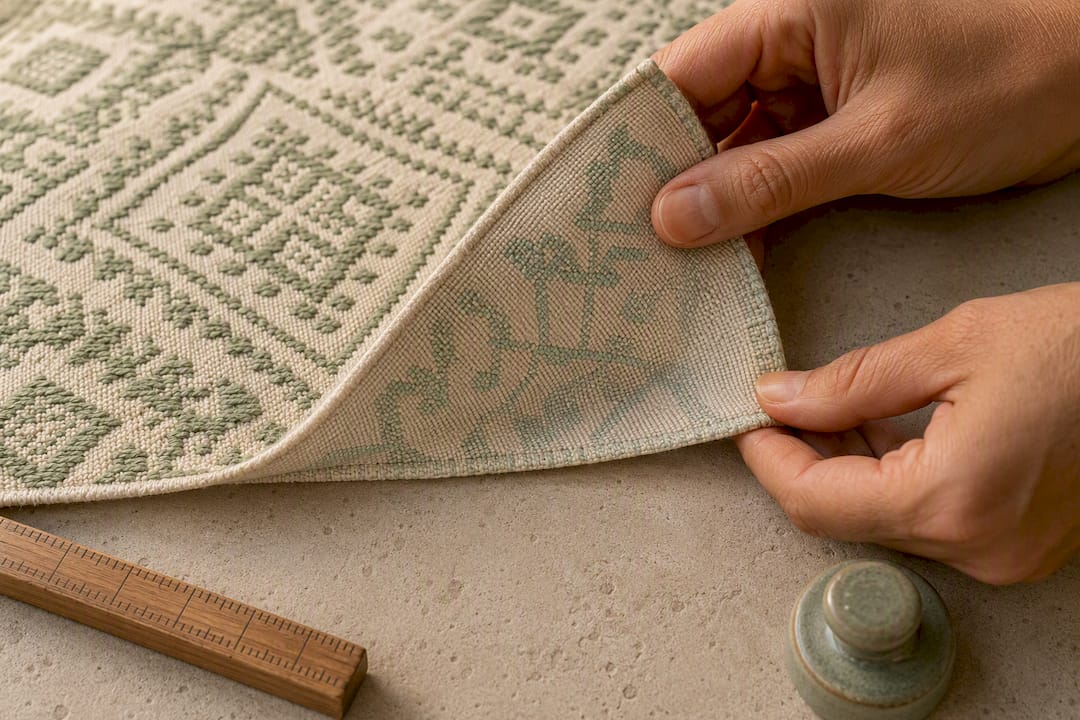
- Two-sided character: jacquard often shows a reversed or softened version of the pattern on the back, since the same threads create both faces. Printed fabric usually shows a flat, blank reverse.
- Design complexity: jacquard can render shading, fine detail, and multi-color imagery that a dobby loom, which is limited to simpler geometric patterns from a smaller set of harnesses, simply can’t produce.
- Cost: yarn-dyeing, longer machine setup, and slower weaving speed all add expense, while printing is a faster, cheaper, after-the-fact process according to the same Decorative Fabrics Direct analysis.
Dobby weaving sits in the middle. It still creates the pattern through the weave structure, which gives it some of jacquard’s durability, but its mechanism only handles smaller, repeating motifs. If you need a bold floral or a detailed figurative design, dobby generally can’t get you there. If you need a subtle stripe, check, or small geometric texture at a lower cost, dobby is often the more sensible choice.
What Are the Main Types of Jacquard Fabric?
Once you know what jacquard weaving is, it helps to recognize its most common forms, because “jacquard” is a technique, not a single look. Fiber choice and structural variation produce noticeably different fabrics.
Damask is probably the most familiar. It’s typically a single-color jacquard where the pattern shows through contrasting sheen, often woven in cotton or cotton and linen blends for table linens and apparel. Brocade takes it further, working in multiple colors and sometimes supplementary metallic or silk threads for a raised, ornamental effect traditionally associated with formal or decorative textiles. Tapestry jacquard mimics the look of hand-woven tapestries, often heavier and used for upholstery or wall pieces, while chenille jacquard uses a fuzzy, textured yarn that gives a soft, almost velvety hand, common in blankets and throws.
Fiber matters as much as structure. Cotton jacquard tends to be breathable and holds a crisp pattern well. Linen blends add a slightly looser drape and a more relaxed hand. Silk jacquard produces the most dramatic sheen and contrast, which is why formal brocades favor it. Polyester and blended synthetics show up often in contract upholstery, where durability and cost matter more than natural fiber content.
One thing worth checking on any jacquard piece: flip it over. According to FibreGuard’s explainer on jacquard construction, the reverse side typically shows a color-reversed or texture-reversed version of the front pattern, a direct result of the weave structure rather than a printed surface. For upholstery specifically, look at the weight and any backing treatment, since heavier jacquards with reinforced backing tend to carry higher double-rub ratings, the industry’s way of measuring abrasion resistance for furniture fabric.
Where Is Jacquard Weaving Used Today?
Jacquard shows up in far more places than most people realize once they start looking for it. In fashion, it’s behind textured robes, kimonos, lightweight jackets, and structured dresses, anywhere a designer wants visual interest that doesn’t rely on printing. In home textiles, it covers upholstery fabric, curtains, decorative tapestries, and contract fabric for hospitality and commercial interiors, where durability under repeated use actually matters.
Bespoke and small-batch weaving has become genuinely viable in a way it wasn’t a generation ago. Designers can now convert artwork directly into digital weave files, and electronic Jacquard heads process those files with far less changeover delay than the old punched-card systems required. That shift is a big reason small studios and independent brands can commission original jacquard patterns without needing an industrial-scale order, a change echoed in broader conversations around design trade programs and production flexibility across the textile and interiors world.
- Fashion apparel: robes, kimonos, jackets, structured outerwear
- Home textiles: upholstery, curtains, decorative throws, contract fabric
- Art and bespoke commissions: woven portraits, custom imagery, textile art
- Small-batch production: digital weave files make short runs financially realistic
Pro Tip: If you’re planning a jacquard design, lock in your yarn colors early. Because the pattern is woven from pre-dyed threads, changing a color after the yarn is dyed means starting over, which is a far costlier mistake than adjusting a printed design after the fact.
What Makes Indijio’s Jacquard Cotton Robes Different?
I want to be clear about something: “jacquard” describes a weaving method, not a fiber, a quality tier, or a promise that something was made by hand. It simply tells you the pattern was woven into the cloth rather than printed on top of it. That’s the detail I find most useful when I’m shopping for textiles myself, and it’s the same standard we hold our own robes to.
Our jacquard cotton kimono robes are made in Türkiye using this woven construction, which is why you’ll notice actual texture under your fingers rather than a flat printed surface. Because of how the pattern is built, the inside of the robe often shows a softer, reversed version of the design instead of a blank lining, which gives it a nice, considered feel even where no one else sees it.
These robes work harder than a typical bathrobe. I wear mine as a lightweight jacket over a linen dress on cooler evenings, as a cover-up walking back from the pool, and as an actual robe at home after a shower. Try belting it snugly over swimwear for a beach layer, or leaving it open over jeans and a simple tank for something closer to a jacket. Weight and drape vary by design, so it’s worth checking each product page for the specifics before you decide how you’ll wear yours most.
How Do You Care for Jacquard Fabric?
Jacquard holds up well, but the woven pattern and yarn-dyed color deserve a bit of attention. Because the design comes from dyed threads rather than surface ink, jacquard generally resists fading better than printed cloth, but that doesn’t mean it’s immune to wear from harsh washing.
Cold or lukewarm water is usually gentler on jacquard than hot water, which can stress the dye and the weave over repeated washes. A mild detergent without bleach protects both the color and the structural threads that create the pattern. Turning the piece inside out before washing helps protect the raised texture on the front from friction against a washer drum or other garments.
Skip the high heat in the dryer if you can. Air drying or a low tumble setting keeps the fibers from shrinking unevenly, which matters more with jacquard than a flat weave because the pattern threads and background threads can react to heat slightly differently. If you’re dealing with heavier jacquard, like upholstery-weight fabric or a thick chenille jacquard, spot cleaning is often safer than a full wash, and checking the manufacturer’s specific care label is always worth the extra minute.
One habit that helps any woven pattern last: avoid wringing or twisting jacquard fabric to remove water. Press excess moisture out gently instead, then lay flat to dry when possible. It’s a small step, but it protects the structure that makes jacquard worth choosing in the first place.
Find Your Own Jacquard Cotton Robe
If everything above has you wanting to feel the difference for yourself, that’s exactly the point. Indijio makes small-batch, natural-fiber robes and textiles in Türkiye, and our jacquard cotton pieces are woven, not printed, so the texture and reversible pattern you just read about are the actual construction, not a marketing description. Twenty percent of our profits go toward regenerative land projects and community-led initiatives, which means choosing a well-made piece also supports something beyond your closet.
If you want to see the weave up close, start with the Elephant Jacquard Natural Cotton Kimono Robe for a bold, graphic take, or look at the Ocean Evil Eye Jacquard Cotton Kimono Robe and the Hera Evil Eye Jacquard Natural Cotton Kimono Robe if you’re drawn to the evil eye motif many of our customers gift again and again. Each product page lists its own weight, fit, and care details, so check those before you order, and reach out if you have questions about which one suits how you actually plan to wear it.
Sources
- The Jacquard loom: Innovation in textiles and computing — National Museum of Scotland
- Jacquard weaving — Wikipedia
- Explainer: what are jacquard fabrics? — FibreGuard
- Printed vs jacquard fabric — Decorative Fabrics Direct
FAQ
What Is Jacquard Weaving Fabric?
Jacquard weaving fabric is cloth where the pattern is built into the weave structure using individually controlled warp threads, rather than printed onto a plain woven surface afterward.
How Do You Make a Jacquard Weave?
A pattern file, whether a punched card historically or a digital file today, tells control rods which warp threads to lift through hooks and heddles, opening a shed for the weft thread to pass through and build the design row by row.
What Is Special About Jacquard Looms?
Jacquard looms give individual control over each warp thread instead of grouping threads into a small number of harnesses, which lets them weave far more intricate, non-repeating patterns than a standard dobby loom.
Why Is Jacquard So Expensive?
Jacquard costs more mainly because the yarn is dyed before weaving, the loom setup is more complex, and the weaving process runs slower than fabrics that get their pattern printed on afterward.
Is Jacquard the Same as Handmade?
No. Jacquard describes the weaving method itself, whether run on a mechanical or electronic loom, and it doesn’t guarantee a specific fiber, quality level, or that a piece was made entirely by hand.