

Founder's Take: Why the Peshtemal Still Works From Hammam to Beach
A peshtemal is a flat-woven Turkish towel, traditionally made from cotton, with fringed ends and none of the thick looped pile you find on a terry towel. It began as the towel of choice in Ottoman-era hammams, where its light weight and quick drying mattered more than plush softness. That same flat weave is exactly why it has found a second life today as a beach towel, travel companion, and home textile.
TL;DR:
- Peshtemals are flat-woven Turkish towels originally used in hammams for quick drying and modesty, now popular as lightweight beach, travel, and home textiles.
- The core difference from terry towels is the weave: peshtemals are lighter, dry faster, and resist sand due to the absence of loops, which also allows them to soften over time.
- Most modern production involves a blend of machine-made and hand-finished techniques, with regional Anatolian patterns adding cultural authenticity and variety.
- Proper care includes washing in cool or warm water without softeners, air drying or tumble drying on low, and checking fiber content and dimensions before purchasing.
- Authentic Turkish peshtemals are still made in small batches in Türkiye, and selecting those with visible hand-tied fringes and clear origin details ensures quality and tradition.
Table of Contents
- What Is a Peshtemal, and Where Did It Come From?
- How the Peshtemal Worked Inside the Hammam
- Flat Weave vs. Terry: What Actually Makes a Peshtemal Different
- Modern Life, Modern Uses: Care and a Buying Checklist
- Why I Trust the Lale Cotton-Linen Turkish Towel to Represent This Craft
- What a Peshtemal Still Means, Beyond Function
- The Environmental Side of Peshtemal Production
- How Peshtemals Are Woven Today
- Indijio’s Take on Bringing This Tradition Home
- Sources
- FAQ
What Is a Peshtemal, and Where Did It Come From?
The peshtemal’s story starts in the hammam, not the beach bag. Historical accounts trace its use back to Ottoman-era bathhouses, where bathers needed something that could wrap around the body for privacy and dry quickly in a room thick with steam, according to Handwoven magazine’s history of Turkish towels. A thick towel would have stayed damp and heavy in that environment. A flat, thin weave did the opposite: it shed water fast and dried almost as quickly as it got wet.
The name itself carries a piece of that history. “Peshtemal” comes from the Persian puştmāl, meaning roughly “back towel,” and the same object shows up under different regional names, including fouta in parts of North Africa, according to Wikipedia’s entry on the peshtemal. Weaving communities in Anatolian towns such as Denizli and Buldan have kept versions of this tradition going for generations, with local patterns and stripe combinations that once signaled where a towel came from or who wove it, according to a conference paper on Anatolian weaving traditions.
A rough timeline of how the peshtemal moved from bathhouse essential to everyday textile:
- Ottoman era: Used primarily in hammams for modesty and quick drying, with some ornate versions reserved for weddings, births, or palace use, per Handwoven.
- 19th and early 20th century: Regional weaving centers in Anatolia refine local patterns, turning the peshtemal into both a practical object and a marker of regional identity.
- Mid to late 20th century: Industrialization introduces power looms alongside handweaving, making peshtemals more widely available and affordable.
- 21st century: Tourism and export demand reposition the peshtemal as a lifestyle item, sold internationally as a beach and travel towel.
I grew up around these towels without ever thinking of them as anything special. They were just what you brought to the hammam. It took leaving Türkiye to realize how unusual, and how genuinely useful, that flat weave really is.
How the Peshtemal Worked Inside the Hammam
Inside a traditional hammam, the peshtemal did double duty. Bathers wrapped it around the waist or body while moving through the steam rooms, which kept things modest in a communal bathing space, and then used the same cloth to dry off afterward, per Handwoven. It wasn’t the only object in that ritual. Copper bowls called tas were used to pour water, wooden clogs called nalın kept feet off the wet marble floors, and olive oil soap was standard. The peshtemal was simply the textile that tied all of it together.
Design and use varied by region and sometimes by gender, with certain stripe patterns or fringe styles associated with specific towns or with towels meant for women versus men. None of this was standardized the way a modern product spec sheet would be. It developed the way most textile traditions do: by trial, by region, and by what worked in a hot, wet room.
Pro Tip: If you want a rough sense of whether a peshtemal was made with real attention to craft, look at the fringe. Hand-tied, slightly uneven twisted fringe usually signals handwork, while a perfectly uniform, machine-finished edge usually means a faster production process.
Flat Weave vs. Terry: What Actually Makes a Peshtemal Different
The core technical difference between a peshtemal and a standard bath towel is the weave itself. A peshtemal uses a flat weave, similar to what you’d see in a woven blanket, while a conventional towel uses terry construction with raised loops of yarn that create that thick, plush pile. Peshtemals are typically woven from long-staple cotton, sometimes blended with linen, and finished with fringed or hemmed edges rather than a bound border.
That structural difference shows up in everyday performance. Because there’s no dense pile trapping water, a flat-woven towel is lighter, more packable, and dries considerably faster than a terry towel of similar size, according to Terralina’s comparison of Turkish towels and terry cloth. The lack of loops also means sand doesn’t cling to it the way it does to terry, which is one reason peshtemals took off as beach towels.
| Comparison point | Flat-woven peshtemal | Terry towel |
|---|---|---|
| Weight/packability | Lighter, folds small | Heavier, bulkier |
| Drying speed | Fast | Slower |
| Sand resistance | Shakes off easily | Sand sticks in loops |
| Longevity/softening | Softens with washing | Can stiffen or pill over time |
A separate technical comparison of towel weaves backs up the drying-speed gap, noting that flat-weave and terry towels behave quite differently once wet, with flat weaves releasing moisture much faster, according to Terralina’s weave comparison. One detail worth knowing before you buy: unlike terry towels, which can stiffen or start pilling after repeated washes, a good flat-woven cotton towel tends to get softer the more you use it, per Terralina. When you’re comparing options online, look for a stated fiber content (cotton, or a cotton-linen blend), an even weave without loose threads, and fringe that looks hand-finished rather than glued or heat-sealed.
Modern Life, Modern Uses: Care and a Buying Checklist
The peshtemal’s original design brief, light, absorbent for its weight, and fast-drying, turns out to be exactly what a beach towel, gym towel, or travel towel needs. That’s not a coincidence so much as a design that traveled well past its original purpose. Today you’ll see peshtemals doing duty as pool and spa towels, sauna wraps, picnic layers, lightweight throws on the back of a sofa, and even table runners or wall accents in homes that like their textiles to work harder than one job.
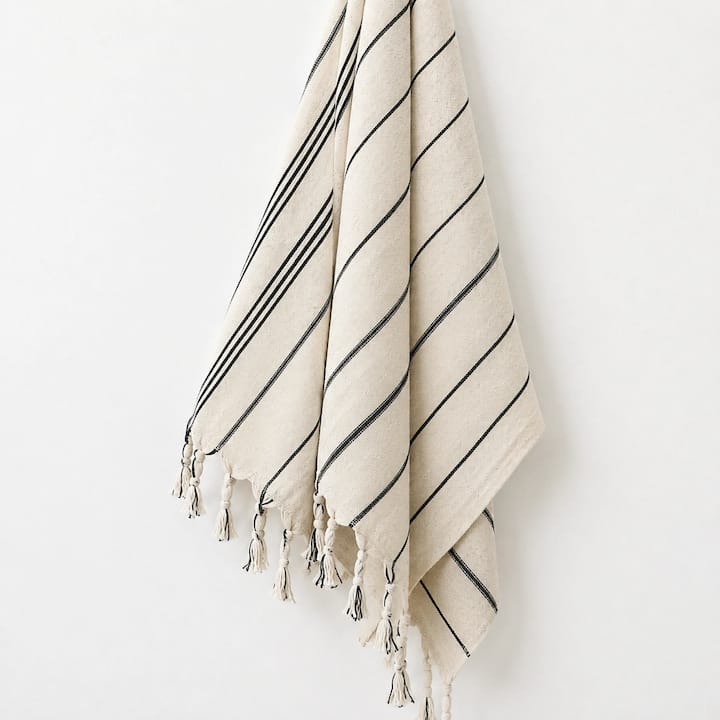
Caring for one is simple, but a little different from a plush towel. Wash in cool or warm water, skip the fabric softener (it coats the fibers and can reduce absorbency over time), and let it air dry or tumble on low. The first few washes are the transition period. A brand-new peshtemal can feel a bit stiff or thin compared to a thick towel, and that’s normal. It loosens and softens with use, which is part of the appeal rather than a flaw.
If you’re shopping for one, run through this short checklist before you buy:
- Size. Larger peshtemals double as wraps or throws; smaller ones suit gym bags and travel.
- Fiber content. Cotton or a cotton-linen blend affects softness, drape, and drying speed.
- Weave quality. An even, tight flat weave holds up better over years of washing.
- Fringe finish. Hand-tied fringe is a common sign of more traditional production.
- Origin claim. Look for a clear statement of where and how the towel was made, rather than a vague “inspired by” description.
Pro Tip: Sand shakes off a peshtemal far more easily than it does off a terry towel, but giving it one firm snap in the air before you fold it up saves you from tracking sand into your bag or car.
Why I Trust the Lale Cotton-Linen Turkish Towel to Represent This Craft
I started Indijio because I wanted to bring pieces of Turkish textile tradition, made in Türkiye, to people who’d genuinely use and appreciate them, not just display them. The Lale Cotton-Linen Turkish Towel is part of that. It’s woven flat rather than looped, made in small batches, and built around the same practical logic that made peshtemals useful in hammams centuries ago: light enough to pack, absorbent enough to matter, and quick to dry.
Before you buy any peshtemal, ours or anyone else’s, check the product page for the specifics that actually affect how it performs for you:
- The exact fiber content (cotton, cotton-linen blend, or another mix)
- The listed dimensions, since “generous size” means different things to different people
- The weight, which affects both packability and how substantial the towel feels
- The washing and care instructions specific to that item
I’d rather you check those details for yourself than take a marketing description at face value, on our site or anywhere else. If you want to see how the fiber choice affects feel and drape more broadly, our piece on why Turkish cotton feels different goes deeper into that. And if you’re weighing cotton against a cotton-linen blend for warmer climates or year-round use, our comparison of cotton and linen fabrics walks through the tradeoffs, even though that piece was written with kimonos in mind rather than towels.
What a Peshtemal Still Means, Beyond Function
Strip away the practical benefits for a moment and the peshtemal still carries something worth noticing: it’s one of those objects that moved from ritual to routine without losing its identity. In Turkish culture, the hammam was never just about getting clean. It was a social space, tied to milestones like weddings and births, and the peshtemal you brought or were given could reflect that occasion. Ornate versions were sometimes made specifically as gifts or ceremonial pieces, distinct from the plainer towels used for daily bathing, per Handwoven’s historical account.
That symbolic weight hasn’t disappeared so much as expanded. A peshtemal gifted today, whether it’s a housewarming present or something tucked into a travel bag, still carries a small echo of that older tradition of textiles marking a moment rather than just serving a function. Regional patterns that once signaled which town a towel came from now signal something closer to craft and origin. A striped Buldan-style weave or a specific fringe technique tells you this object has a place it comes from, not just a use it serves.
I don’t think it needs to be romanticized to matter. It’s enough to say that a textile which once marked a wedding gift in an Ottoman household is the same basic object you might throw over a beach chair or a bathroom hook today. Few everyday items carry that kind of range.
The Environmental Side of Peshtemal Production
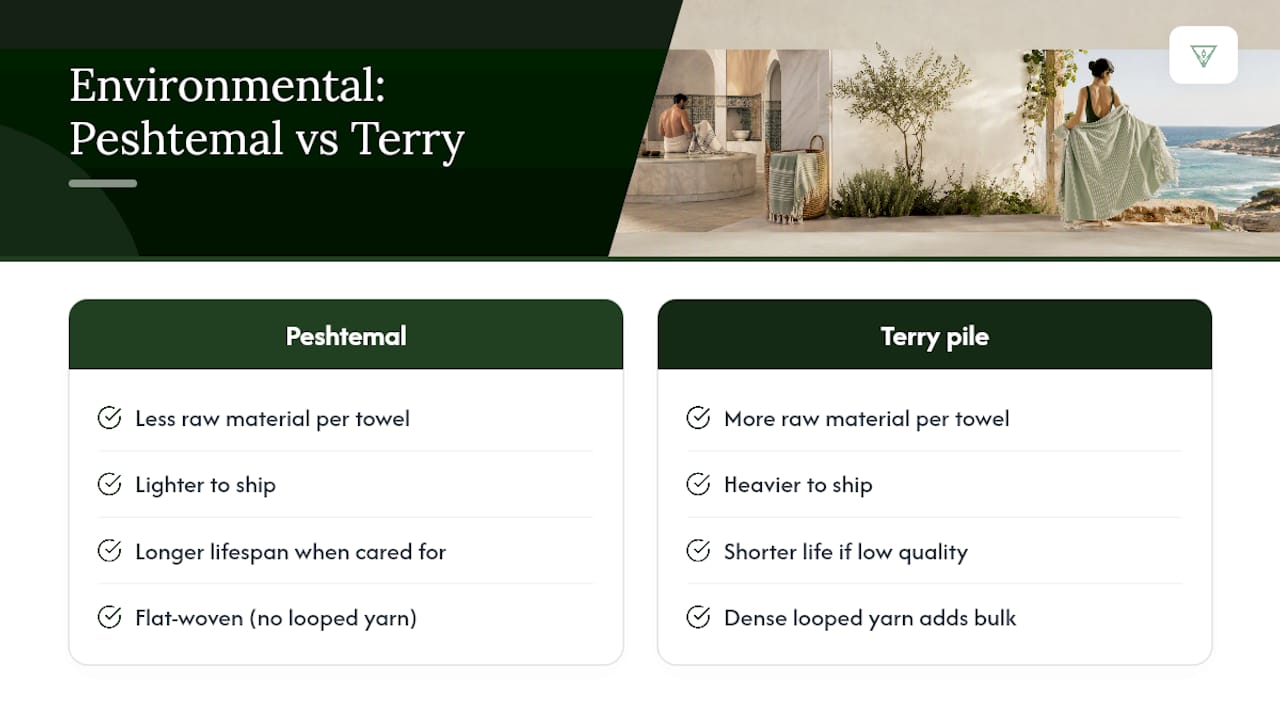
Peshtemal production sits inside the same environmental conversations that apply to cotton textiles generally: water use in cotton farming, dye processes, and how far a product travels before it reaches you. None of that is unique to peshtemals specifically, and it’s worth being honest about that rather than claiming a single towel style solves textile sustainability on its own.
What does seem to hold up, structurally, is that a flat-woven towel uses less raw material per towel than a dense terry pile does, since there’s no looped yarn adding bulk and weight. A lighter textile generally means less material consumed and less weight to ship, though the actual footprint of any individual towel depends heavily on how and where it was produced, what dyes were used, and how it’s cared for over its lifespan. A peshtemal that gets used for years, softening rather than wearing out, also tends to outlast a lower-quality towel that pills and gets replaced after a couple of seasons. Longevity is its own quiet form of sustainability, even without any formal certification behind it.
If sustainability matters to you as a buyer, the most honest advice is the least exciting one: ask about fiber origin, ask how the towel was woven and finished, and favor pieces you can see yourself actually using for years rather than pieces bought for a single trip. A towel that lasts is doing more for the planet than a towel with a sustainability label but a short life in your closet.
How Peshtemals Are Woven Today
Contemporary peshtemal production sits somewhere between the fully handmade past and full industrial automation, and honestly, most production today involves some blend of the two. Power looms handle a large share of commercial peshtemal weaving now, which makes the towels more consistent and more affordable than they’d be if every one were handwoven start to finish. That’s part of why peshtemals became accessible enough to become a global beach and travel item rather than staying a regional specialty.
At the same time, certain steps still tend to involve hands-on work, particularly finishing details like fringe tying. A hand-tied twisted fringe, as opposed to a machine-hemmed edge, is one of the more reliable visual signs that some manual finishing went into a particular towel. Regional weaving centers in Anatolia, including towns like Denizli and Buldan, continue to support weavers who work in these traditions, and local heritage projects have made a point of keeping those specific techniques and patterns from disappearing entirely as mass production expanded, according to the research on Anatolian weaving traditions.
For a shopper, this matters less as a purity test and more as a question worth asking. A towel doesn’t need to be entirely handwoven to be well made, but knowing whether a brand can tell you anything about where and how a towel was produced tells you something about how much they actually know about their own supply chain.
Indijio’s Take on Bringing This Tradition Home
If everything above has you thinking a peshtemal might actually solve a few problems in your own life, that’s the whole point of this piece. You don’t need a hammam to appreciate a towel that packs small, dries fast, and gets softer every time you wash it.
Indijio makes natural-fiber textiles, including cotton and cotton-linen pieces, in small batches with artisans in Türkiye, which is where this tradition actually comes from rather than somewhere we’re borrowing it from. Unlike a mass-market beach towel picked mainly for a low price, a peshtemal from a brand rooted in this craft tends to come with more honest detail about fiber, weight, and origin, since that information is part of the story rather than an afterthought. We also direct 20% of profits toward regenerative land projects, community infrastructure, and Indigenous-led initiatives, so a purchase connects to something beyond the transaction itself.
If you want to see the flat-woven cotton-linen construction described throughout this piece in an actual product, the Lale Cotton-Linen Turkish Towel is worth a look, whether you’re picturing it on a beach chair, a spa bag, or a hook in your bathroom. And if you’d rather browse the fuller range first, our cotton and linen collection is a reasonable place to start comparing sizes, weights, and weaves side by side. Check the material, size, and care details on any piece before you buy. That habit will serve you well no matter whose towel ends up in your bag.
Sources
FAQ
What does peshtemal mean?
“Peshtemal” comes from the Persian puştmāl, meaning “back towel,” and refers to the traditional Turkish flat-woven towel historically used in hammams, according to Wikipedia.
What is a peshtemal used for today?
Beyond its original hammam role, a peshtemal now works as a beach towel, travel towel, spa or sauna wrap, gym towel, picnic layer, lightweight blanket, or home accent like a throw or table runner.
Is a peshtemal the same as a Turkish towel?
Yes, “peshtemal” and “Turkish towel” generally describe the same flat-woven textile, though “Turkish towel” is the more common term used in Western retail.
How is a peshtemal different from a regular bath towel?
A peshtemal uses a flat weave instead of the looped terry pile found on standard bath towels, which makes it lighter, more packable, faster-drying, and more resistant to holding sand, per Terralina’s comparison.
Do peshtemals get softer with use?
Yes. Flat-woven cotton towels tend to soften with repeated washing, while terry towels are more prone to stiffening or pilling over time, according to Terralina.